

Great D.O. are not created; they are discovered
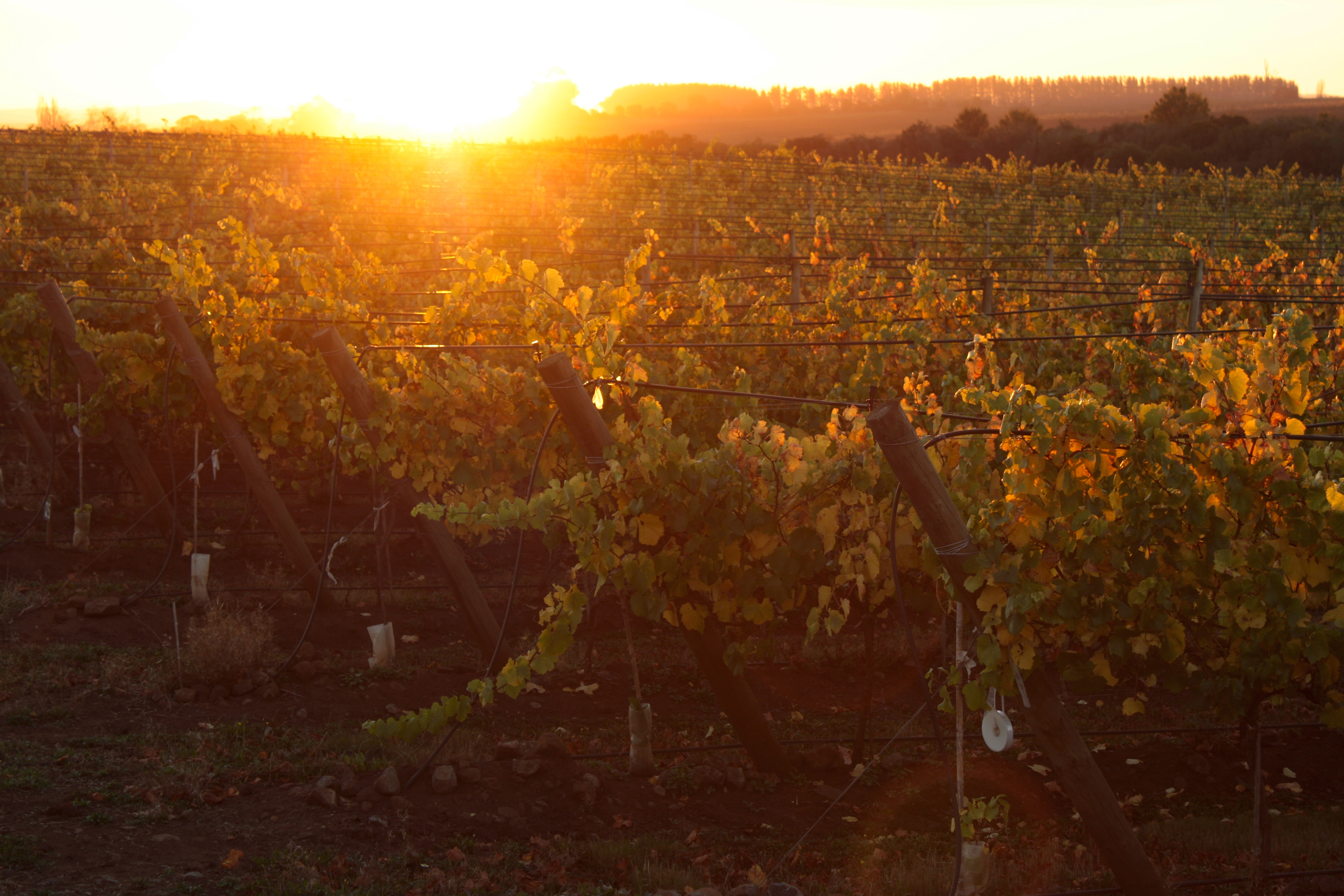
Being open to others naturally leads us to openness toward new experiences and latitudes. Not only in the mountainous reaches of the Maipo Valley, but also at the southern frontier of Chile’s viticultural potential. Climate change opened the way to unique volcanic terroirs such as the Malleco Valley, and we were among the first to plant there, at the La Golondrina estate, in 2007. After trialing various cool-climate varieties, the results ultimately revealed the great potential of Sauvignon Blanc, Chardonnay, and Pinot Noir.
We also wanted to be among the first to plant there, at the La Golondrina estate, in 2007. After trialing various cool-climate varieties, the results ultimately revealed the great potential of Sauvignon Blanc, Chardonnay, and Pinot Noir.
The nearby town is called Quino, which means “between rivers.” These reddish soils of volcanic origin contain abundant stones and a high clay content. Temperatures are low and annual rainfall exceeds 900 mm—climatic conditions that are more reminiscent of Burgundy than of Chile’s warm Central Valley—resulting in vibrant acidity and lower alcohol levels.
A wine with character and identity, showing freshness and intensity in the glass. A new era and a new understanding of what Chile’s far south represents. A wine that clearly expresses its place, its origin, its terroir.

The red soils of Quino, in the Malleco Valley, with volcanoes on the horizon.
.
.
.


Creating A.O.C.
When many were surprised that Don Víctor planted in the Maipo Canyon, today we have succeeded in including our Boca Chica vineyards in San José de Maipo within the Pirque D.O., at the easternmost edge of the Maipo Valley, and our Quino vineyards in the Traiguén D.O. of the Malleco Valley. But our goal goes further: to create D.O.C.—controlled designations of origin. Enhancing origin with quality criteria: origin is a brand to protect.
A.O.C. (Appellation d’Origine Contrôlée) was created in France at the beginning of the 20th century as a way to protect the origin and quality of wines against fraud and imitation. The idea was simple: a wine should clearly reflect the place it comes from. To achieve this, rules were established regarding which grape varieties could be planted, how vineyards were managed, how much fruit could be produced, and how the wine was made. Over time, this system helped highlight the concept of terroir—the relationship between soil, climate, and human work.
The French model had a profound influence on the wine world and was adopted, with various adaptations, in many countries. This gave rise to controlled quality appellations in Europe, the Americas, and other regions, all with the same goal: to guarantee consumers a clear origin and a minimum quality standard, while protecting the identity of each territory. This is precisely what CASAFÈVRE aims to begin doing—from Pirque, across Chile, and to the world.

Pioneering Spirit
When, in the early 1990s, Don Víctor and Mr. Fèvre were the first to plant high-end vineyards at the altitude of the Maipo Canyon, everyone was surprised. “It snows here, sir, and the winds are harsh—your vines will all die.” Fortunately, they insisted, showing a spirit rare in winemaking: the courage to plant in unknown places, guided more by careful observation of the land and intuition than by established rules.
It is a way of daring to read the climate, soils, and landscape with an open mind, accepting the risk of mistakes in order to discover new expressions of wine. Thanks to this drive, many now-renowned regions were born from curiosity, patient work, and the conviction that a place can tell its own story through the vine.
Studies confirmed that their intuition was correct. Many soil pits were dug, leaving deep holes across all the estates to examine the composition of different layers. Electromagnetic surveys were conducted, with someone on a motorcycle scanning each row to measure clay concentration. A small plane was also used to photograph the vineyards and assess canopy development.

The results became increasingly evident: a perfect combination of alluvial and colluvial soils for three key factors, especially for Cabernet Sauvignon—water balance, nutrient diversity, and good drainage.
Courage and Passion
Something common at CASAFÈVRE is courage. It is evident in the passion—not only in winemaking, but throughout life. This love story of Mr. Fèvre is proof of that.
Their love story is so intense it seems taken from a movie; in fact, many believe it inspired the script for Before Sunrise. Before World War II, William Fèvre returned to France after completing his military service in the Balkans. During a train journey through Austria, he met Helga Hincks, a 17-year-old Austrian girl traveling with her family. They fell in love immediately, and he stayed in Vienna for a few days, trying to build something he believed would last forever.
Upon returning to France, they kept in touch through letters, until Helga was urgently sent to England due to the imminent Nazi invasion. Her parents died during the war, and William spent years trying to find her, without success, convinced she had died. Helga, meanwhile, married an English doctor and built her life. Decades later, now a widow, her daughter requested a bottle of Chablis during a lunch. On the table appeared a bottle bearing the name of the man her mother had always said she loved deeply.


Her daughter insisted so much that Helga finally called Chablis. Upon hearing her voice, William Fèvre—already in his eighties—recognized her immediately and told her to take the first train to see him. From that day on, they were reunited. Undoubtedly, a story with enough passion to inspire a great wine.
Moving forward in love is like moving forward in everything we are passionate about. What we desire does not exist unless we seek it, and the pursuit—or the journey—is part of the pleasure.